What Happens If You Don’t Replace a Missing Tooth?
Many patients believe that losing a single tooth — especially near the back of the mouth — isn’t a major problem. A very common question we hear is:
“Do I actually need to replace a missing tooth?”
The truth is that even one missing tooth can gradually affect your oral health, bite, appearance, and confidence over time.
If you’re considering dental implants, this guide explains what can happen when a missing tooth is left untreated and why replacing it early can often prevent more complex issues later on.
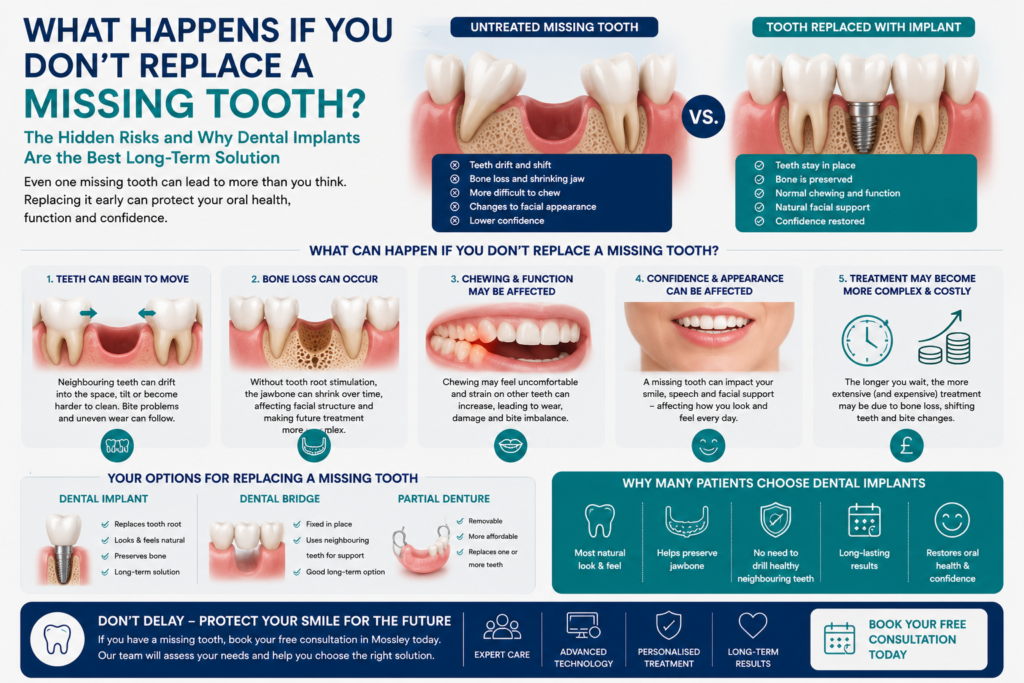
Teeth Can Begin to Move
Your teeth are constantly supported by neighbouring and opposing teeth. When a tooth is lost, nearby teeth may begin to:
- Drift into the empty space
- Tilt forward or backward
- Become more difficult to clean
The tooth above or below the gap can also begin to over-erupt because it no longer has an opposing tooth to bite against.
This can eventually affect your bite and may create uneven tooth wear.
Learn more about replacing missing teeth
Bone Loss Can Occur
One of the biggest long-term consequences of tooth loss is jawbone shrinkage.
Natural tooth roots stimulate the jawbone whenever you chew. Once a tooth is removed, that stimulation reduces, and the bone in that area can slowly shrink over time.
This may lead to:
- Changes in facial structure
- Reduced gum support
- Difficulty placing implants later if too much bone is lost
Dental implants are unique because they help maintain bone by replacing the root of the tooth.
Chewing and Function May Become More Difficult
Missing teeth can place additional strain on surrounding teeth, particularly if you begin chewing more heavily on one side.
Patients may notice:
- Difficulty chewing certain foods
- Food trapping in the gap
- Increased wear on remaining teeth
- Changes in bite balance
Confidence and Appearance Can Be Affected
Even if the missing tooth is not immediately visible, many patients become more self-conscious over time.
Front tooth loss can particularly affect:
- Smiling confidently
- Speech
- Facial support and lip position
Replacing missing teeth can restore both appearance and confidence.
What Are the Options for Replacing a Missing Tooth?
There are several ways to replace a missing tooth:
Dental Implant
A titanium implant replaces the root of the tooth and supports a custom crown.
Dental Bridge
A fixed restoration attached to neighbouring teeth.
Partial Denture
A removable option designed to replace one or more missing teeth.
Why Many Patients Choose Dental Implants
Dental implants are often considered the closest option to a natural tooth because they:
- Look and feel natural
- Help preserve jawbone
- Don’t require drilling neighbouring teeth
- Provide long-term stability
With proper care, implants can last many years and help maintain both oral health and smile aesthetics.
Take the First Step Toward Restoring Your Smile
If you have a missing tooth and are unsure whether to replace it, the best next step is to book a free consultation in Mossley.
We’ll assess your oral health, discuss your options, and help you decide on the most suitable treatment for your smile and long-term dental health — with no cost or obligation.